A few weeks ago, we shared our 7 investment themes for 2026. We’re now publishing a series of discussions to deeper dive into these themes. This article outlines our thinking on theme [1] The System of Record Shakeout. It focuses on the administrative and clinical-enablement work and workflows.
Thorsten Wirkes
•
" height="22px" id="RsSmyFbKt" width="22px"/><path d="M 1.658 3.12 C 0.65 3.12 0 2.426 0 1.56 C 0 0.673 0.67 0 1.697 0 C 2.723 0 3.355 0.673 3.375 1.56 C 3.375 2.425 2.724 3.12 1.678 3.12 Z M 4.84 13.381 C 4.84 13.33 4.879 5.2 4.84 4.353 L 7.84 4.353 L 7.84 5.633 C 8.24 5.017 8.952 4.14 10.546 4.14 C 12.52 4.14 14 5.43 14 8.204 L 14 13.38 L 11 13.38 L 11 8.55 C 11 7.338 10.566 6.51 9.48 6.51 C 8.65 6.51 8.156 7.068 7.94 7.606 C 7.86 7.799 7.842 8.069 7.842 8.339 L 7.842 13.381 Z M 3.178 4.352 L 0.176 4.352 L 0.176 13.38 L 3.178 13.38 Z" fill="rgb(255, 255, 255)" height="13.38098413085936px" id="CifiBBlfG" transform="translate(4 4.31)" width="13.999996337890593px"/></g></svg>)
" height="22px" id="XQwyT_g75" width="22px"/><path d="M 10.57 0 L 12.621 0 L 8.118 5.092 L 13.378 12 L 9.251 12 L 6.018 7.802 L 2.318 12 L 0.267 12 L 5.037 6.553 L 0 0 L 4.23 0 L 7.15 3.835 L 10.571 0 Z M 9.852 10.804 L 10.989 10.804 L 3.633 1.151 L 2.411 1.151 Z" fill="rgb(255, 255, 255)" height="12px" id="tcEw8CyN1" transform="translate(4.313 5)" width="13.378px"/></g></svg>)
" height="22px" id="P70CkYWtM" width="22px"/><path d="M 9.484 5.408 L 9.372 5.522 C 8.748 6.16 7.893 6.519 7 6.516 C 6.107 6.519 5.251 6.16 4.627 5.522 L 4.515 5.408 L 0.805 9.18 L 13.194 9.18 Z M 7 5.368 C 7.59 5.368 8.14 5.137 8.554 4.718 L 13.194 0 L 0.805 0 L 5.447 4.717 C 5.86 5.137 6.412 5.368 7.001 5.368 Z M 3.712 4.59 L 0 0.819 L 0 8.361 Z M 14 0.819 L 10.29 4.59 L 14 8.361 L 14 0.82 Z" fill="rgb(255, 255, 255)" height="9.179999992370606px" id="MQJjTnR9n" transform="translate(4 6.41)" width="14px"/></g></svg>)
The System of Record Shakeout
For over a decade, healthcare software - and healthcare itself - has been organized around the Systems of Record (SoRs): the EHRs, CRMs, QMS tools, ERPs, and many others that store data and manage workflows. For EHRs (HITECH act) and QMSs (21 CFR 820/210 & 211), this was driven by regulatory requirements, for others it was a more market-driven evolution.
At first, these SOR systems were designed to mirror existing workflows. Yet over time, something shifted: they started to dictate the workflows rather than assisting in them. The SoR became the center of gravity.
But recently that’s changing. A new category is emerging: Systems of Action (SoA). These are often AI-powered tools that sit on top of existing systems of record, allowing work to flow more naturally, including fundamentally rethinking workflows that the SoR had long-since calcified. For the purpose of this discussion, we also include Services companies that are moving to autonomous processes as SoAs (We will discuss Services x AI in our deep dive on topic [2] Labor Productivity Supercharged).
To illustrate, here is an example: In med tech, compliance workflows touch the CRM, QMS, and ERP simultaneously. At present, no single system of record owns the full picture. That lack of a one-stop-shop requires humans to stitch together manual workflows, sometimes referred to as ‘swivel chair API’. It also creates an opening for a system of action that sits across all three, orchestrating workflows, surfacing insights, generating new data, and automating tasks that would otherwise require the human toggling between systems. Companies like Flinn.Ai, a BHI portfolio company, are building the SoA to address this specific issue.
As investors, we ask ourselves how will the rise of the SOA play out? Who will win, the systems of record or the systems of action?
Will the SORs absorb the SOA functionality? Meaning, the overlays become features rather than stand-alone companies. For instance, this is a common argument around scribe companies, that perhaps EHRs will natively offer these features.
Or will the systems of action become the primary interface? Meaning, the SoR fades into the background as (database) infrastructure. The example in SaaS companies here is the rise of Gong or Chorus layering on top of Salesforce, the CRM system, that then sits more in the background. In a more extreme future, SoAs might add database capabilities and replace the systems of record.
As we’ve been speaking with founders, operators, technologists, market experts, and other investors, we believe the answer is, as in most cases: it depends.
The answer varies by market depending on incumbent strength (market position, investment ability, tech orientation), IT system fragmentation, novelty of data, customer lock-in, regulatory dynamics, technical strengths, and other factors. Here is the double-click:
A framework for everyone building in the space
Here’s how we assess who we will think will win. It also serves as a framework for (aspiring) builders on how and where to build.
[1] Incumbent strength: If the incumbent is distracted or hamstringed SOAs have a good shot at winning. The incumbent’s constraints might be financial (ability to invest), cultural, technical capabilities, their willingness/ability to disrupt themselves (e.g., new products, new pricing models) or a combination thereof. For instance, EHR vendors historically underinvested in behavioral health, which opened the door for companies like Eleos. Similarly, in a few other specialties investor-owned EHRs have capital constraints that cause them to underinvest in technology. Or think of Veeva, it built its pharma commercial business when Salesforce wasn't paying attention to life sciences. In the early days you could easily say Veeva was a Salesforce “wrapper”, but in Veeva’s case they owned the market and then became the dominant player. Strong incumbents are a cautionary tale; we expect them to absorb SOA functionality.
[2] Data - throttle & novelty: If an SOA can either control the flow of data (throttle) or generate truly novel (read: unique) data, it has a great shot at building a lasting business. The inverse is true if the SOR controls the flow or generates this data. On data flows: If organizations become the gateway to adding data into the SOR, they can disintermediate them by building the required workflows and underlying databases. On novelty: Patient continuous monitoring, human conversations and thinking, human behavior logging, as well broader environmental monitoring are currently under-captured. Those who unlock this data are well placed (think how Spotify unlocked our music preferences and listening habits).
[3] IT fragmentation: If workflows span multiple systems of record, overlay solutions have an edge. Historically, we have used human labor as an overlay, i.e., services. Interesting areas are provider prior auth / billing (EHR, CRM, financial systems), med tech compliance (which spans CRM, QMS, and ERP), care coordination (EHR, care management, pharmacy, patient communication), and clinical trial operations (EDC, CTMS, IRT, safety databases, regulatory submission systems). The question here is not whether SORs or SOAs win, but whether incumbent service providers win vs newly emerging SOAs.
[4] Workflow reliance on human interaction: The more the completion of a workflow relies on human interaction, the better for the SORs. In those situations, they have a higher degree of lock-in towards their customers. Here it’s important to distinguish if the process natively requires human input. Today, many processes seem to require human input, but only a fraction of the process truly does. It’s often a function of poor process design or historical technological constraints (which AI removes). Here lies the real opportunity for SOAs: Figure out where human input is not natively required and push these workflows into a headless background – just like many eligibility verification (except the data capture) and claims processing steps are already happening without human intervention.
[5] Customer lock-in: In cases where customers have high loyalty to their SORs, they are well positioned to win. This might be due to high switching cost (financial, time), aversion to switching by an influential user group, etc. To win, SOAs need to identify the source of the lock-in and render this barrier obsolete. For example, acute EHRs have a high lock-in right now. If SOAs demonstrated to physicians that their lives are significantly better and to CFOs that the cost of switching tends towards nil, the EHRs’ lock-in would dissipate.
[6] Regulatory dynamics: Regulation plays an important role in determining who succeeds and on what timeframe. Just as regulation facilitated the advent of EHRs and QMSs as referenced above, it continues to act as a stabilizing force for these SORs. That said, depending on the content it might also become a catalyst for SOAs, either because new regulation benefits a new type of solution, or because SOAs find a way to help customers more effectively work within the confines of the existing regulatory framework. In either case, SOAs need to be keenly aware of the regulatory impact in their niche. At minimum, SOA companies need to neutralize the headwinds. At best, they find a way to make them a tailwind.
[7] Technical strengths: This factor is less about the market forces but about the specific companies and founders technical capabilities and agency. The question is: In an autonomous, LLM-driven world, who can provide high fidelity outputs. The importance varies by workflow. It will matter most where there are regulatory, civil, or even criminal penalties associated with getting it wrong, e.g., in clinical trials, med tech compliance, clinical treatment decisions, risk adjustment coding.
You will notice that in all of this we’re not referencing technological moats. While certain players will have technologically advanced solutions at least for a period of time, we believe that, at the application layer, technology and the ability to build it become a quasi-commodity.
A tool we use
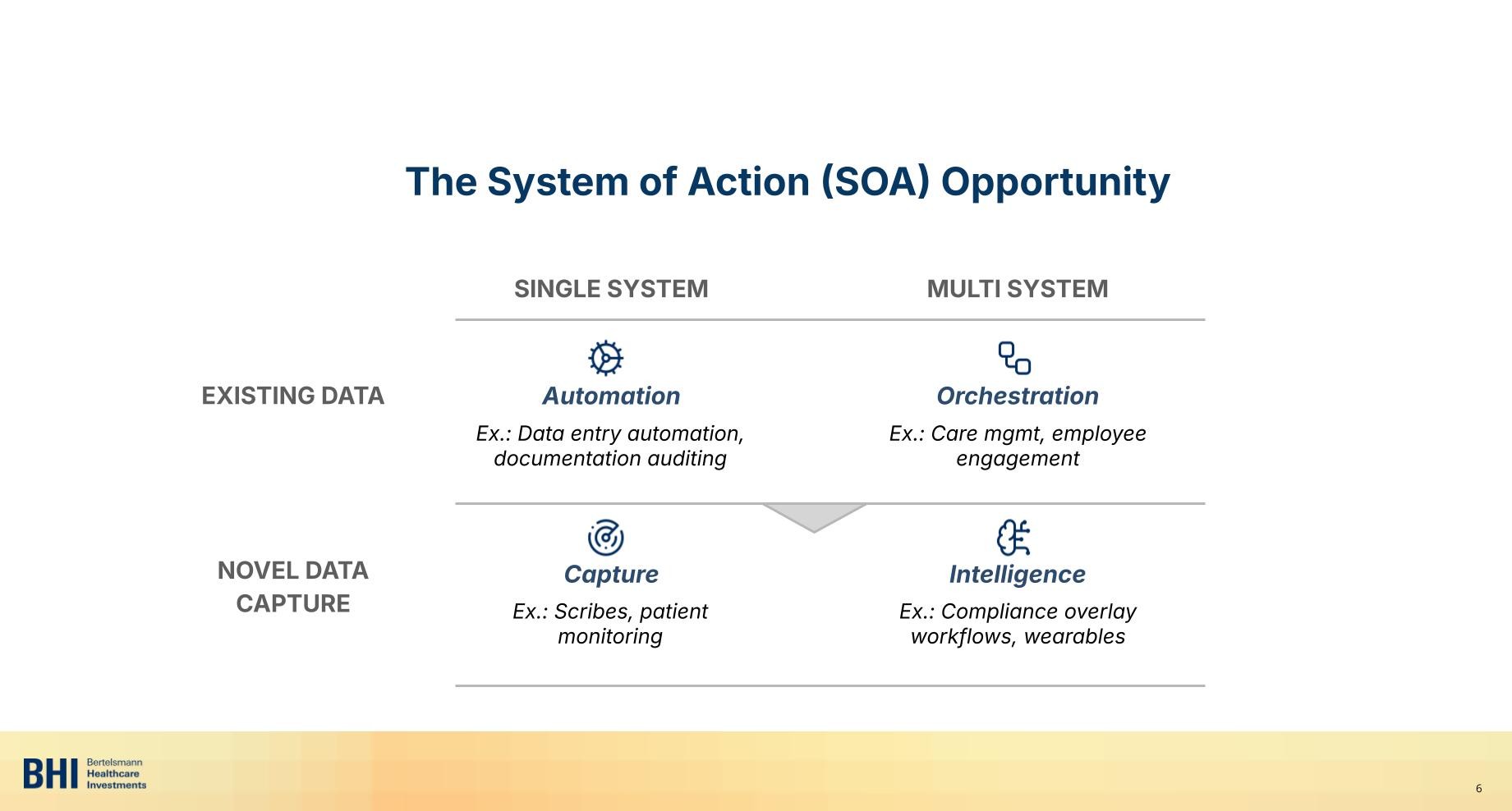
To close out this discussion, we’re sharing a matrix we’ve found useful in discussing investment opportunities. It plots companies along two of the above dimensions: Degree of fragmentation and novelty of data. It facilitates a conversation on what’s novel about a new SOA and what the potential moats could look like (While this matrix has been a helpful tool, any decision on where to play and to invest should include all the above factors.).
For what it’s worth, we’re expecting almost all SOAs to start pushing down towards ‘novel data capture’ to create a moat.
Reflecting on what we know, and don’t know
Open questions on how all of this will exactly play out certainly remain. Two elements we’re especially curious about are a) the role of services companies (more in the deep dive on [2]) and b) whether first mover advantages continue to matter. Historically, first mover advantages at the application layer arose because the cost of building a new SOR was prohibitively high once the market had been captured by incumbents. With the cost of building technology decreasing sharply and us observing a high willingness to switch between SOA solutions, these sources of a first mover advantage might vanish. Potentially, other sources might arise such as the compounding effects of novel and proprietary data access.
Lastly, much of the above is framed as ‘who will win’. In the end, reality will look less binary, especially in healthcare. We will see new types of data and database companies, we will see headless workflow engines, we will see SOA point solutions, we will see SOAs with a services wrapper, and many other permutations.
We want to talk with you
We’re curious to hear from you on this topic. Do you agree? Where do you disagree and why?
We're also actively looking for founders building in this space. Happy to chat.
— Thorsten Wirkes, Bertelsmann Health Investments
PS: Many thanks to Andrea Coravos for helping to develop this article. And for all of those who provide input and feedback. Much appreciated.


